|
|
Ajuga
|
 Part Sun to Light Shade
 Zone: 5-7 2" tall Origin: Japan Zone: 5-7 2" tall Origin: Japan
Open House/Web-Only!
Okay, I'd probably grow this just for the name, but imagine my excitement when it turned out to be a cool garden plant as well. Most ajugas don't fare well in our heat and humidity, but to my surprise, Ajuga 'Planet Zork' has performed wonderfully in our garden trials. This compact selection comes from Japan where its slow clumping growth habit and upwardly cupped, crinkled, grey-green, deer-resistant leaves with a pink overlay are highly prized. Superficially, it looks like Ajuga 'Burgundy Glow' that was sprayed with weedkiller...a likely leftover from the "better gardening through chemicals" program. Pot size: 24 fl. oz (709.77 ml) #06721
|
 Part Sun to Light ShadeZone: 6-8, possibly colder 6" tall Origin: Hybrid
NEW!
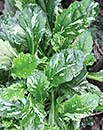
We have been very impressed with the performance of this stunning new Ajuga x bastarda (A. decumbens x A. yesoensis) from the folks at Terra Nova. The plant started its life in Japan and was stabilized by Takuya Izumi, who named it A. 'Hanabi'. Terra Nova took it to Oregon, doubled the chromosomes, and behold, Ajuga 'Sparkler'. The slowly spreading patch is composed of narrow, jagged dark green, deer-resistant leaves with lovely white speckling, reminiscent of a low-bid paint job. Ajuga 'Sparkler' is one of the most distinctive and humidity-loving, non-melting selections we have grown. I still don't understand the x bastarda specific epithet since we know the baby daddy...perhaps they just weren't properly wed. Pot size: 24 fl. oz (709.77 ml) #08883
|
|
Alcea
|
 SunZone: 3-8a 72" tall Origin: Russia
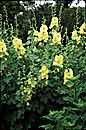
This superb but rarely encountered hollyhock from Russia has been one of the best performers in our display garden. From an evergreen basal rosette of corrugated grey-green leaves, tall sturdy 6-7' spikes arise, beginning in spring. The spikes are clothed along the bottom half with typical hollyhock foliage, while the top half is adorned all summer with large 4" single buttery-yellow flowers. For us, A. rugosa has proven to be a reliable and disease-resistant perennial compared to other hollyhock species. Pot size: 24 fl. oz (709.77 ml) #04469
|
|
Allium
|
 SunZone: 5-8, at least 12" tall Origin: Hybrid
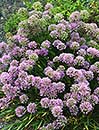
This stunning A. nutans hybrid comes from the Onion Man, Mark McDonough. A. 'Millennium' represents several generations of breeding (onions) and is head and shoulders above any other alliums we grow. The compact 1' tall x 1' wide clump of narrow glossy green, deer-resistant leaves is topped for over a month in late summer with 2" rosy-purple flower heads. We grow A. 'Millennium' in several locations and have never seen any sign of a stray seedling...garliccimo! Pot size: 24 fl. oz (709.77 ml) #05466
|
 SunZone: 3-8 12" tall Origin: Siberia
NEW!
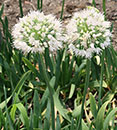
This delightful form of the Siberian Allium nutans was shared with us by our friend and garden writer, Pam Harper. Allium nutans 'Pam Harper' is composed of 8" long x 0.5" wide, slightly twisted, glaucous, deer-resistant leaves topped with 15" tall spikes that end with 2" floral balls. The clump begins flowering in early June and reflowers through the end of September. The flowers are pure white except where the nights are cool, when they may take on a light pink cast. Pot size: 24 fl. oz (709.77 ml) #08841
|
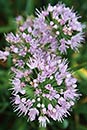 SunZone: 3-8 12" tall Origin: Hybrid
NEW!
We have grown Allium 'Pink Feathers' since 1993 and have always found it to be a dependable, easy-to-grow, drought-tolerant gem for the rock garden. In 10 years, expect a 20" wide clump of rosettes, each composed of 10" long glossy green, slightly twisted, deer-resistant leaves. The clumps are topped starting in early July with 1' tall spikes, ending in 2" spheres of light lavender flowers. Best of all, we haven't seen any seedlings in 15 years. Pot size: 24 fl. oz (709.77 ml) #08814
|
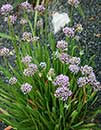 SunZone: 5-8, at least 6" tall Origin: Hybrid
Open House/Web-Only!
We had almost given up on alliums after growing far too many weedy species but have been delighted to find great non-weedy hybrids, thanks to Allium guru Mark McDonough. This hybrid of Mark's combines the best traits of both Allium nutans with the popular Allium senescens. Allium 'Sugar Melt' has been a standout in our rock garden, making a 6" tall x 8" wide circular clump of narrow, green, deer-resistant leaves, topped in early July (later in colder climates) with 16" stems of light pink flower balls...a perfect rock garden plant. Pot size: 24 fl. oz (709.77 ml) #06402
|
|
Alocasia
|
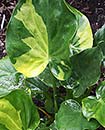 Sun to Part SunZone: 7b-10 36" tall Origin: Burma, India
Open House/Web-Only!
This quirky little elephant ear has fared very well in our trials for the last 5 years. In shape, it resembles a vigorous form of typical Alocasia cucullata, forming 3' tall x 3' wide clumps of small, twisty, thick, glossy green leaves. This particular selection has leaves that are bordered with an irregular, narrow yellow edge...a plant for collectors who need every one. Pot size: 24 fl. oz (709.77 ml) #07588
|
 Sun to Light ShadeZone: 7b-10 72" tall Origin: India
(syn: Alocasia macrorrhiza) This very cool elephant ear is quite different from the typical C. esculenta. The thick sculpted, glossy green leaves are held upright on dramatically rigid stems. A clump of giant upright elephant ears are guaranteed to stop visitors in their tracks...especially if they walk into it! A. macrorrhizos has been quite hardy in the Raleigh area, surviving 0 degrees F, but prefers it a bit warmer. Pot size: 2 qt. (1.892 L) #01160
|
 Sun to Part SunZone: 7b-10 36" tall Origin: Vietnam
In 2005, we were botanizing north of Hanoi and after finding our road washed out, we retreated through a series of uninteresting back roads until sighting this bizarre form of the common Alocasia macrorrhizos in the front yard of a small home. The owner gladly shared a piece that we subsequently named A. 'Shock Treatment'. This mutation of A. macrorrhizos is a 3' tall clumper with glossy green bizarrely twisted and crinkled leaves resembling a larger version of Alocasia cucullata 'Crinkles'. So far, this has proven as winter hardy as regular A. macrorrhizos. Pot size: 24 fl. oz (709.77 ml) #07121
|
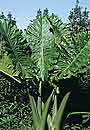 Sun to Part SunZone: 7b-10 96" tall Origin: Hybrid
(syn: A. x portora 'Portodora') This superb alocasia hybrid was selected by Ron Weeks, from seedlings of a cross made by LariAnn Garner of Aroidia Research. This hybrid of A. odora x A. portei makes a stunning upright clump that is essentially an improved A. macrorrhizos. Each giant, green, heavily-scalloped leaf is held sturdily upright atop the thick muscular purple stalks. This is truly an architectural specimen plant for any garden. As with all elephant ears, a moist, rich organic soil is best. A good thick winter mulch helps prevent rot in cold, wet soils. Pot size: 2 qt. (1.892 L) #03654
|
 Part Sun to Light ShadeZone: 7b-10 36" tall Origin: New Guinea
Although this hardy and easy-to-grow elephant ear was first described in 1916, the true species is still virtually unknown in horticultural circles (thanks to Peter Boyce formerly of Kew Gardens for confirming the identity of our specimen). From the remote mountains of New Guinea, Alocasia wentii is one of the very few alocasias we have found to be winter hardy in our Zone 7b climate. The glossy bronze-green leaves reach 1' in length as they adorn this tightly clumping elephant ear. As the breeze blows, you will enjoy the contrasting metallic-purple leaf backs. Pot size: 24 fl. oz (709.77 ml) #02967
|
|
Aloe
|
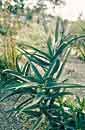 SunZone: 7b-10 40" tall Origin: S. Africa
Open House/Web-Only!
From the wilds of South Africa comes this amazing species with upright stalks of 1" wide, dark green foliage. In warmer climates, the stalks can reach in excess of 3'. The larger stalks tend to arch outward with age due to excess weight...as do we. In early summer, the clumps are topped with amazing scapes of orange-yellow bells. This is one for the plant nut who likes to push the limits of hardiness. In Zone 7, you will need to provide great drainage and protect the foliage from excess winter moisture to avoid slight foliage burn or rot...we planted ours under the eaves of the house, but either a cloth or upside down pot would do the trick. Pot size: 24 fl. oz (709.77 ml) #04037
|
|
Aloysia
|
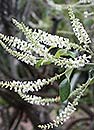 SunZone: 7b-10 96" tall Origin: Argentina, Brazil
We have grown Aloysia virgata since 2001 and in that time it has become one of our favorite summer flowering plants. In our climate, it dies to the ground in winter and behaves as a 8' tall perennial, where in more southerly climates, it makes a large open shrub to 15'. The upright woody stems are clothed with dark green sandpapery leaves. Starting in July and continuing until a hard frost, the branches end in terminal spikes of extremely fragrant white flowers that serve as an attractant for butterflies, other cool insects, and garden visitors. The intoxicating fragrance of vanilla almonds is strongest in late afternoon and evening. Pot size: 24 fl. oz (709.77 ml) #07587
|
|
Alpinia
|
 Part Sun to Light ShadeZone: 7b-10 20" tall Origin: China, Japan, Taiwan
Open House/Web-Only!
This wonderful Japanese selection of the hardy Alpinia japonica is no relation to any member of the 1990's English pop group. The upright, glossy green, 1' long, fragrant leaves are heavily splashed with creamy white, making an eye-catching addition to the woodland garden. Occasionally, the clumps will throw an all-green division, which is more vigorous and should be removed. In spring, the clumps are topped with white flowers with red stripes on terminal spikes...stunning!
Pot size: 24 fl. oz (709.77 ml) #06037
|
|
Alstroemeria
|
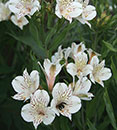 SunZone: 7b-9, at least 40" tall Origin: Hybrid
NEW!
Alstroemeria 'Casablanca' is one of the most amazing alstroemerias we have grown in the garden. Although it was hybridized for the cut flower trade, it has proven to be amazingly winter-hardy for us since 2006, enduring 7 degrees F with no problem. The 3' wide clump produces 40" tall stalks topped, starting in early June, with clusters of large white flowers, flushed with pink on the back and flecked with maroon markings on the flower face. Alstroemeria 'Casablanca' flowers continuously for us all summer...simply outstanding. Pot size: 24 fl. oz (709.77 ml) #08689
|
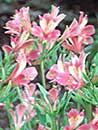 Sun to Part SunZone: 5b-8, at least 30" tall Origin: Hybrid
We are pleased to present this wonderful introduction from the breeding program of Mark Bridgen of Cornell University. A. 'Freedom' boasts similar heat- and cold-tolerance to that of A. 'Sweet Laura'. The winter rosettes of green foliage give rise from June through September to 30" tall spikes of peachy red flowers (RHS 53D), highlighted at the tip of the uppermost two petals with a bold white pattern, speckled with carmine. A. 'Freedom' has proven to be much more of a clumper in contrast to the more common runner, A. psittacina. Pot size: 24 fl. oz (709.77 ml) #04159
|
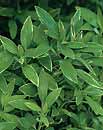 SunZone: 5b-8, at least 30" tall Origin: Hybrid
Open House/Web-Only!
We are truly excited by this variegated sport of the wonderful Alstroemeria 'Sweet Laura' that was discovered at Connecticut's Sunny Border Nursery. The upright stalks are clothed with thumb-shaped green leaves edged with a creamy yellow border, adding more interest to an already fabulous perennial. Alstroemeria 'Glory of the Andes' begins flowering in early July in NC with 30" tall spikes of orange and continues until fall. Even when it's not in flower, Alstroemeria 'Glory of the Andes' provides great foliage interest in the garden. The longer we grow this, the more impressed we are with this great alstroemeria. Pot size: 24 fl. oz (709.77 ml) #05364
|
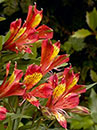 SunZone: 7b-9 24" tall Origin: Hybrid
Alstroemeria 'Koadore' is a great new alstroemeria from the Inca series developed at K�nst Alstroemeria of Holland. A. 'Koadore' makes a 2' tall x 18" wide clump of stalks that flower starting in late June (NC) and continue until fall. The attractive red flowers are each highlighted by a wide yellow band and small brown flecks. Pot size: 24 fl. oz (709.77 ml) #08696
|
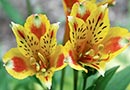 SunZone: 8-9 24" tall Origin: Hybrid
Open House/Web-Only!
This tight clumping hybrid from Holland's K�nst Alstroemeria is topped from late June (NC) until frost with 2' tall stalks of yellow flowers, each highlighted by orange blotches and small brown freckles...very nice! Pot size: 24 fl. oz (709.77 ml) #08695
SOLD OUT
|
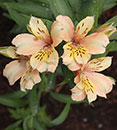 SunZone: 7-9, at least 18" tall Origin: Hybrid
NEW!
Alstroemeria 'Koice', from Holland's K�nst Alstroemeria, has been a star in our trials as well as at Walters Gardens in Michigan. For us, the clumping Alstroemeria 'Koice' begins flowering in early June and continues nonstop until frost. The 18" tall stalks are topped with clusters of light peach flowers highlighted with cinnamon flecks. Although this plant has only been subjected to 0 degrees F, it could prove to be even hardier. Pot size: 24 fl. oz (709.77 ml) #09113
|
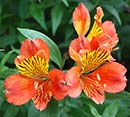 SunZone: 7-8, at least 24" tall Origin: Hybrid
Open House/Web-Only!
Alstroemeria 'Kotrop' from Holland Konst Alstroemerias produces 2' stalks starting in late June (NC), topped with peachy flowers, each highlighted by a large brown-flecked yellow lip. These non-spreading hybrids are a great source of cut flowers for summer arrangements. These have been winter hardy in Western Michigan trials. Pot size: 24 fl. oz (709.77 ml) #08694
SOLD OUT
|
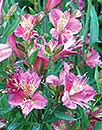 Sun to Part SunZone: 6-8a, at least 30" tall Origin: Hybrid
NEW!
This 2007 introduction from Cornell's Mark Bridgen makes a compact clumper, topped from mid-June through September with abundant clusters of 30" sturdy, upright spikes that end in rosy-pink flowers, two petals of which are highlighted with a yellow base. Because A. 'Mauve Majesty' makes a tight clump, it is perfect for a small space in a small garden. It has been a great performer in our trials. Pot size: 24 fl. oz (709.77 ml) #08043
|
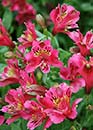 Sun to Part SunZone: 6-8 24" tall Origin: Hybrid
From the breeding program of Cornell's Mark Bridgen (formerly at the University of Connecticut) came this new direction in hardy alstroemeria breeding. A. 'Patricia Lynn' was the first release, with multi-flowered inflorescences of fluorescent red-purple (RHS 61B). Each flower is highlighted by dramatic black lines and a contrasting yellow throat. For us, clumps of Alstroemeria 'Patricia Lynn' are ablaze with flowers from June until October...a superb show in the summer garden. Alstroemeria 'Patricia Lynn' was named in 2000 in honor of the former Connecticut First Lady, Patricia Lynn Rowland. Pot size: 24 fl. oz (709.77 ml) #04643
|
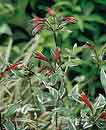 Part Sun to Light ShadeZone: 6b-9a 15" tall Origin: Brazil
Open House/Web-Only!
This Japanese selection improves on the native Brazilian species with dramatic, white-edged leaves. This winter-grower makes a spreading mass of attractive foliage to 15" tall x 3' wide in 6 years (much slower than the species). In June, the flowering stems erupt to nearly 3', each topped with narrow tubular flowers speckled maroon and green...actually quite beautiful. After flowering, the clump goes semi-dormant for the summer, re-emerging in September. Pot size: 24 fl. oz (709.77 ml) #03028
|
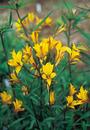 Sun to Part SunZone: 5b-8, at least 30" tall Origin: Hybrid
Open House/Web-Only!
From Mark Bridgen at Cornell University comes this extraordinarily hardy and fragrant princess lily. The winter rosettes of green foliage give rise from June through September to 30" tall stems of golden flowers, highlighted with orange tips and cinnamon specks. The sweet fragrance of the abundant floral display makes this a must for the summer border. In our climate, most princess lilies die of heat stroke when they sample our summers, but not Alstroemeria 'Sweet Laura'. Once established, this Alstroemeria caryophyllaea hybrid spreads very slowly, unlike many of the more aggressive species. Pot size: 24 fl. oz (709.77 ml) #03543
|
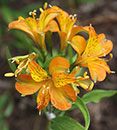 SunZone: 6-9, at least 30" tall Origin: Hybrid
NEW!
Alstroemeria 'Tangerine Tango' is the latest from the breeding work of Cornell's Mark Bridgen and is the orange-flowered counterpart to A. 'Sweet Laura'. This vigorous grower makes a 3' wide patch, topped with 30" tall spikes that end in clusters of narrow-petaled bright orange flowers, highlighted by a yellow blotch and cinnamon flecks. For us, flowering begins in mid-June and continues all summer. Pot size: 24 fl. oz (709.77 ml) #09105
|
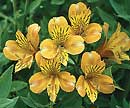 Sun to Part SunZone: 7-9, possibly colder 36" tall Origin: Hybrid
This amazing new hybrid from breeder George Hare of California is little known outside of the West Coast. After several years in our trials, it has ranked as one of our top performers. This sterile cross of A. 'Harmony' and A. aurantiaca is a vigorous grower topped virtually all summer with 3' tall flower stalks with clusters of large, medium orange flowers, each with a purple-flecked lip. The back of the petals also has a lovely contrasting burnt-maroon flush. Whether you enjoy them in the garden or take them indoors as cut flowers, this is a real winner! Pot size: 24 fl. oz (709.77 ml) #04160
|
|
xAmarcrinum
|
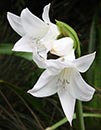 SunZone: 7-10, at least 20" tall Origin: Hybrid
This stunning xAmarcrinum (hybrid of Amaryllis belladonna x Crinum) originated as an open pollinated (result of wild, unprotected sex) seedling in a Fresno, California garden. It was subsequently spotted and named after its conception method by bulb collector Herb Kelly around 1980. The 20" tall spikes of flowers, which open pale pink and quickly change to pure white, start for us in late summer and continue until fall. This is a rarely offered gem, available only in limited quantities. Pot size: 24 fl. oz (709.77 ml) #07930
|
 SunZone: 7-10, at least 24" tall Origin: Hybrid
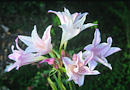
xAmarcrinum is one of those rare man-made wonders rivaling the Great Pyramids! This bigeneric hybrid of Amaryllis belladonna x Crinum moorei produced one of the most fabulous bulbous perennials for the South. The short, glossy, strap-like leaves to 18" give rise in the hottest part of summer to 2' stalks, each topped with 6-8 large, lovely pink, exquisitely fragrant flowers. As soon as one stalk finishes flowering, another emerges, and this flowering pattern continues until frost. In colder climates, xAmarcrinum makes a superb potted specimen! Pot size: 24 fl. oz (709.77 ml) #01408
|
|
Amicia
|
 SunZone: 7b-9, at least 84" tall Origin: Mexico
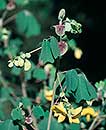
When plantsman Sean Hogan shared this with me under the guise of it being hardy, I had to laugh. Despite being native in the Mexican mountains, I never expected it to survive our winters. Despite a late planting and a severe hit-and-run with a rabid wheelbarrow, up it came in spring like nothing had happened. This Martian-looking pea relative makes a 7' tall, upright perennial with glaucous green foliage that folds up at night. Near the top of the fuzzy stems, the leaf axils are adorned with funny-looking, purple-stained bibs. The stalks are also adorned with large, yellow, pea-like flowers throughout the summer and until frost. Pot size: 24 fl. oz (709.77 ml) #06198
|
|
Ammocharis
|
 Sun to Part SunZone: 7b-9, at least 12" tall Origin: S. Africa
Open House/Web-Only!
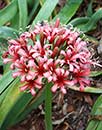
Ammocharis are some of many bizarre South African bulbs that make great garden subjects, but are still far too little-known outside of their native habitats. We have been very impressed with the performance of ammocharis in our gardens over the last several years. This native of seasonally wet, hot, sandy soils emerges in late spring with 12" long x 1" wide, glaucous, strap-like, ground-hugging leaves. Imagine a crinum run over by a steamroller, and you have the picture. In mid-June in NC, the flower cluster containing 25-50 nerine-like, rich pink flowers emerges on a 8-12" tall stalk. Pot size: 24 fl. oz (709.77 ml) #05830
|
| <Agave II] | [Amorphophallus> |
|